Paschal Ponderings
An Easter Excerpt From G.K. Chesterton

“No two things could possibly be more different than the death of Socrates and the death of Christ. We are meant to feel that the death of Socrates was, from the point of view of his friends at least, a stupid muddle and miscarriage of justice interfering with the flow of a humane and lucid, I had almost said a light philosophy. We are meant to feel that Death was the bride of Christ as Poverty was the bride of St. Francis. We are meant to feel that his life was in that sense a sort of love-affair with death, a romance of the pursuit of the ultimate sacrifice. From the moment when the star goes up like a birthday rocket to the moment when the sun is extinguished like a funeral torch, the whole story moves on wings with the speed and direction of a drama, ending in an act beyond words…
When Apollonius the ideal philosopher is brought before the judgment-seat of Domitian and vanishes by magic, the miracle is entirely incidental. It might have occurred at any time in the wandering life of the Tyanean; indeed, I believe it is doubtful in date as well as in substance. The ideal philosopher merely vanished, and resumed his ideal existence somewhere else for an indefinite period. It is characteristic of the contrast perhaps that Apollonius was supposed to have lived to an almost miraculous old age. Jesus of Nazareth was less prudent in his miracles. When Jesus was brought before the judgment-seat of Pontius Pilate, he did not vanish. It was the crisis and the goal; it was the hour and the power of darkness. It was the supremely supernatural act, of all his miraculous life, that he did not vanish.
Every attempt to amplify that story has diminished it. The task has been attempted by many men of real genius and eloquence as well as by only too many vulgar sentimentalists and self-conscious rhetoricians. The tale has been retold with patronizing pathos by elegant sceptics and with fluent enthusiasm by boisterous best-sellers. It will not be retold here. The grinding power of the plain words of the Gospel story is like the power of mill-stones; and those who can read them simply enough will feel as if rocks had been rolled upon them. Criticism is only words about words; and of what use are words about such words as these? What is the use of word-painting about the dark garden filled suddenly with torchlight and furious faces? ‘Are you come out with swords and staves as against a robber? All day I sat in your temple teaching, and you took me not.’ Can anything be added to the massive and gathered restraint of that irony; like a great wave lifted to the sky and refusing to fall? ‘Daughters of Jerusalem, weep not for me, but weep for yourselves and for your children.’…
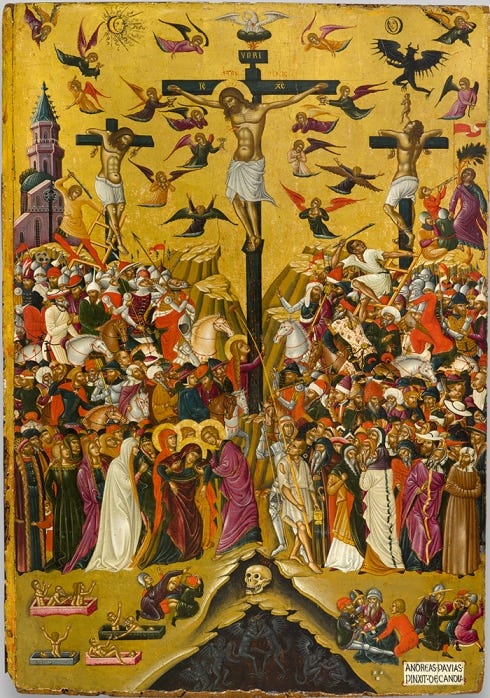
In this story of Good Friday it is the best things in the world that are at their worst. That is what really shows us the world at its worst. It was, for instance, the priests of a true monotheism and the soldiers of an international civilisation. Rome, the legend, founded upon fallen Troy and triumphant over fallen Carthage, had stood for a heroism which was the nearest that any pagan ever came to chivalry. Rome had defended the household gods and the human decencies against the ogres of Africa and the hermaphrodite monstrosities of Greece. But in the lightning flash of this incident, we see great Rome, the imperial republic, going downward under her Lucretian doom. Scepticism has eaten away even the confident sanity of the conquerors of the world. He who is enthroned to say what is justice can only ask, ‘What is truth?’ So in that drama which decided the whole fate of antiquity, one of the central figures is fixed in what seems the reverse of his true role. Rome was almost another name for responsibility. Yet he stands forever as a sort of rocking statue of the irresponsible. Man could do no more. Even the practical had become the impractical. Standing between the pillars of his own judgment-seat, a Roman had washed his hands of the world.
There too were the priests of that pure and original truth that was behind all the mythologies like the sky behind the clouds. It was the most important truth in the world; and even that could not save the world. Perhaps there is something overpowering in pure personal theism; like seeing the sun and moon and sky come together to form one staring face. Perhaps the truth is too tremendous when not broken by some intermediaries, divine or human; perhaps it is merely too pure and far away. Anyhow it could not save the world; it could not even convert the world. There were philosophers who held it in its highest and noblest form; but they not only could not convert the world, but they never tried. You could no more fight the jungle of popular mythology with a private opinion than you could clear away a forest with a pocket-knife. The Jewish priests had guarded it jealously in the good and the bad sense. They had kept it as a gigantic secret. As savage heroes might have kept the sun in a box, they kept the Everlasting in the tabernacle. They were proud that they alone could look upon the blinding sun of a single deity; and they did not know that they had themselves gone blind. Since that day their representatives have been like blind men in broad daylight, striking to right and left with their staffs, and cursing the darkness. But there has been that in their monumental monotheism that it has at least remained like a monument, the last thing of its kind, and in a sense motionless in the more restless world which it cannot satisfy. For it is certain that for some reason it cannot satisfy. Since that day it has never been quite enough to say that God is in his heaven and all is right with the world; since the rumour that God had left his heavens to set it right…
There were solitudes beyond where none shall follow. There were secrets in the inmost and invisible part of that drama that have no symbol in speech; or in any severance of a man from men. Nor is it easy for any words less stark and single-minded than those of the naked narrative even to hint at the horror of exaltation that lifted itself above the hill. Endless expositions have not come to the end of it, or even to the beginning. And if there be any sound that can produce a silence, we may surely be silent about the end and the extremity; when a cry was driven out of that darkness in words dreadfully distinct and dreadfully unintelligible, which man shall never understand in all the eternity they have purchased for him; and for one annihilating instant an abyss that is not for our thoughts had opened even in the unity of the absolute; and God had been forsaken of God.
They took the body down from the cross and one of the few rich men among the first Christians obtained permission to bury it in a rock tomb in his garden; the Romans setting a military guard lest there should be some riot and attempt to recover the body. There was once more a natural symbolism in these natural proceedings; it was well that the tomb should be sealed with all the secrecy of ancient eastern sepulture and guarded by the authority of the Caesars. For in that second cavern the whole of that great and glorious humanity which we call antiquity was gathered up and covered over; and in that place it was buried. It was the end of a very great thing called human history; the history that was merely human. The mythologies and the philosophies were buried there, the gods and the heroes and the sages. In the great Roman phrase, they had lived. But as they could only live, so they could only die; and they were dead.
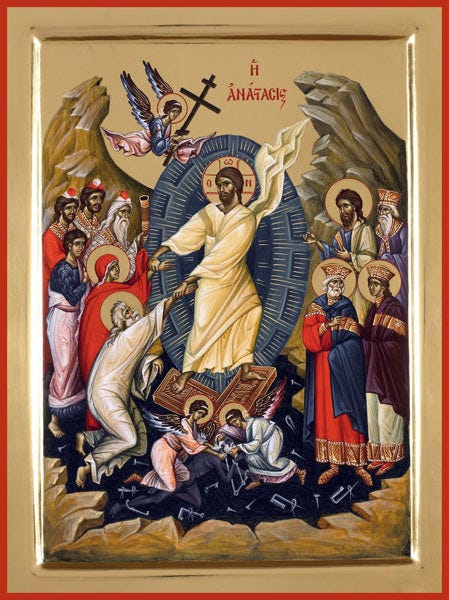
On the third day the friends of Christ coming at daybreak to the place found the grave empty and the stone rolled away. In varying ways they realised the new wonder; but even they hardly realised that the world had died in the night. What they were looking at was the first day of a new creation, with a new heaven and a new earth; and in a semblance of the gardener God walked again in the garden, in the cool not of the evening but the dawn.”
-G.K. Chesterton, The Everlasting Man